
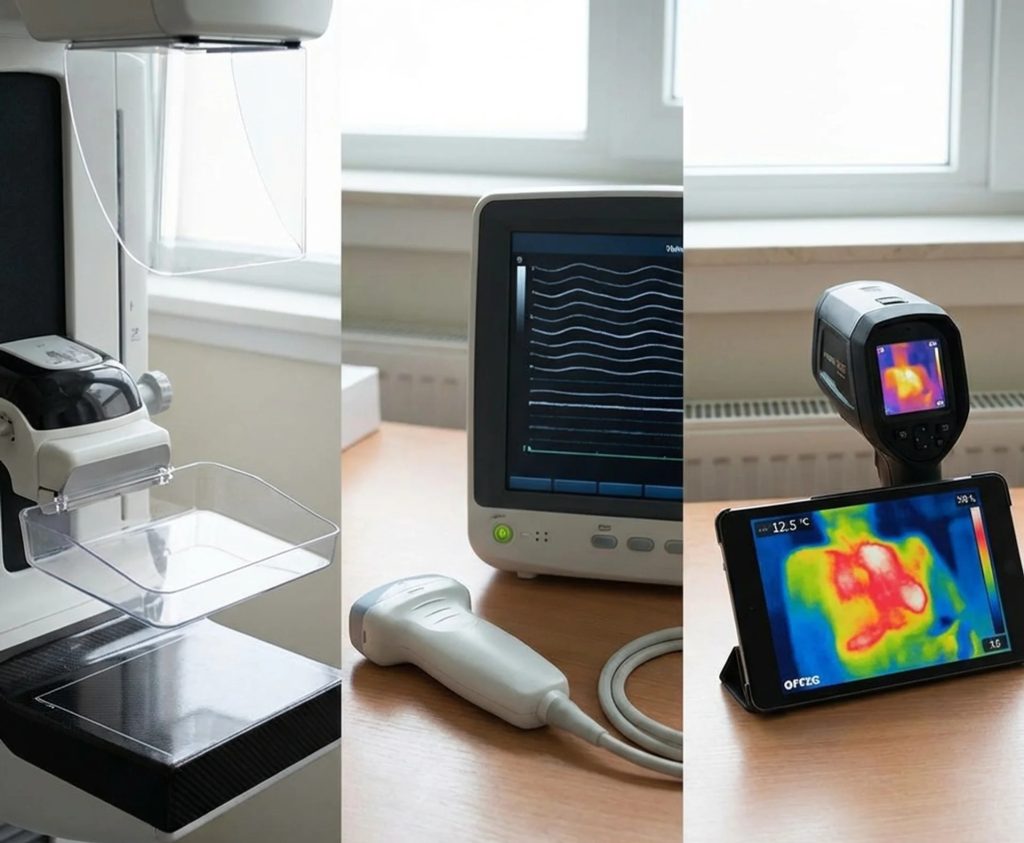
When it comes to your health, especially something as important as your breasts, knowing your options isn’t just empowering—it can be life-saving. You’ve probably heard of mammograms, maybe ultrasounds, and possibly even thermograms. But what actually sets them apart? And more importantly, which one should you trust?
Let’s break it down in a way that actually makes sense.
🩺 Mammograms: The Gold Standard
A mammogram is the most commonly recommended screening tool for detecting breast cancer—and for good reason. It uses low-dose X-rays to look inside the breast and can catch abnormalities long before you’d ever feel them.
For many women, especially over 40, this is the starting point for routine screening. Yes, it can be uncomfortable for a few seconds (no one loves the compression part), but that brief discomfort can lead to early detection, which dramatically improves outcomes. A 3D is preferred for better resolution.
What makes mammograms so important is their ability to detect tiny calcium deposits and very early tumors—things other methods often miss.
🧪 Ultrasounds: The Clarifier
Think of ultrasounds as the “follow-up detective.” Instead of radiation, they use sound waves to create images of breast tissue.
If a mammogram finds something unclear—or if you have dense breast tissue (which many younger women do)—an ultrasound helps doctors figure out what’s really going on. Is it a harmless fluid-filled cyst, or something more serious?
Ultrasounds are painless, quick, and safe. But here’s the catch: they’re not typically used alone for screening because they can miss very small early signs of breast cancer.
🌡️ Thermograms: The Controversial Option
Thermography sounds high-tech—it uses infrared imaging to detect heat patterns and blood flow in the breast. The idea is that cancerous areas may show up as warmer spots due to increased activity.
It’s completely non-invasive. No compression, no radiation, no contact at all—which is why it appeals to a lot of women looking for a more “natural” approach.
But here’s where it gets tricky.
Thermograms are not considered reliable on their own for detecting breast cancer. They don’t actually show what’s happening inside the breast—just temperature changes on the surface. Because of this, they can miss cancers or raise unnecessary alarms.
Most medical organizations do not recommend thermography as a replacement for mammograms.
So, What Does This Mean for You?
Each method has its place—but they are not equal.
Mammograms are still the most trusted and effective way to catch breast cancer early. Ultrasounds are incredibly useful for getting more detail and clarity. Thermograms, while appealing in theory, simply don’t have the scientific backing to stand on their own.
The most important takeaway? Don’t rely on comfort alone when making decisions about your health. The goal isn’t just an easy experience—it’s accurate, early detection.
Final Thought
Taking care of your health isn’t always convenient, but it is powerful. Understanding the differences between these screening tools allows you to make informed decisions, ask better questions, and advocate for yourself with confidence. At your next physical exam appointment, ask about when you are due for your breast cancer screening.
Because when it comes to breast cancer, knowledge truly is one of your strongest defenses.